Tuesday, April 26, 2016

Bantams touch the heart


Bantams come in dozens of colorful varieties. Choose more than one favorite. Lewis Wright, writing in his 1890 Illustrated Book of Poultry about bantams reflects in language of a different time about advantages that still apply today:

Modern Game bantams
“Many a lady, tired of having nothing to pet but a tom-cat, has wondered longingly whether she might not keep a few fowls; but looking at her garden with regretful eyes, has decided that half of it would be needed, and that she could not spare that; when the happy thought has crossed her mind, “Why not keep Bantams?” A little space – just that strip which can so easily be spared – will content them; and as to crowing, who in the world would mind the voice of a little fellow no bigger than a pigeon? She is made happy; and even the tom-cat, ousted at first from his olden place, but who has provided for him a never-ending subject of interest in the perpetually intense speculation as to the possibility of some peculiarly tiny chicken coming some day through to the wrong side of the wire – even he is made happy too. Decidedly, Bantams have their place in the world.”

Old English Game bantams

Monday, April 25, 2016

Kids and Bantams

From Piper's Bantams: Black; Gold and Silver Sebrights; White; and Modern Game
Bantams can be a good way for kids to get involved in poultry. Their small size makes them easy for small hands to manage. Most are gentler than large fowl birds. With some supervision, kids can take responsibility for care and husbandry. They are easier for children -- and adults -- to shampoo for a show.

Poultry can be a lifetime enjoyable hobby or it can lead to a satisfying career. Leadership is needed in the poultry business.

Rosecomb Bantams by Schilling
Joining the American Bantam Association and getting involved in YEPA helps young people succeed. The APA and the ABA joined together in 1995 to create a youth program, and YEPA became an independent organization in 2015. The A.C.E. Program: Activities, Competition, Education is one of the most popular. Kids get started as young as eight years old, and can continue to build their knowledge through four levels, to age 21, at which point they can apprentice to become poultry judges. 
 
“They learn the basics about pure bred, exhibition poultry,” said  Doris Robinson, director of the Youth Exhibition Poultry Association.
 
The program requires members to learn about their breed and others, history, husbandry, candling and hatching eggs, health and medications. They keep notebooks and Health Maintenance Records of their flocks. They track income and expenses to arrive at a financial summary of their project.

"The kids have to work extremely hard,” says Mrs. Robinson. “It’s a great reference for kids who want to go to college in poultry. They go into adulthood with a lot of knowledge.”

More than 1,200 kids are now signed into the program. It is financed by donations from APA, the Crossroads of America Poultry Show and others. Individuals and organizations are invited to become supporters. Contact Mrs. Robinson at 865-717-6270 or through the web site.
One of my bantam Sumatras
 

Monday, March 14, 2016

Blue Copper Marans

Chris Cameron of Camp Ocean Pines acquired five Blue Copper Marans pullets over the weekend. He had a young cock, too, but he was killed by a predator. So Chris figures he'll have fertile hatching eggs for two weeks. He plans to hatch as many as he can. He's willing to sell them if you are in the Cambria vicinity. Contact him at chris@campoceanpines.org.

Black Copper Marans were the first variety recognized. Here's B.A. Davis' Black Copper rooster:

White and Wheaten are also recognized.

Blue Copper Marans aren't yet a recognized color variety, in Marans or any other breed. They are blue where Black Copper Marans are black. Blue Copper reproduces the same way other blue varieties do: incompletely. Typically, about a quarter of the offspring from Blue matings are black, a quarter are splash and half are blue.

Ryan Masterson sent this chart to explain it:


Thursday, February 25, 2016

Countryside Network

Countryside, publisher of Backyard Poultry magazine among others, launched a new network. I'm pleased that they included two of my articles and a positive mention of my book in their first post about chickens, Rule Your Roost.

There's a lot of useful information there, from legal aspects to coop design. For those who are working to get laws changed to make chicken-keeping legal, Jono Miller's Dozen Tips to Legalize Backyard Chickens in Your Community are especially helpful.

Free Download, or view on the web.

Friday, February 12, 2016

Pacific Poultry Breeders show

Jeannette Beranger of the Livestock Conservancy put the photos she took at the Pacific Poultry Breeders poultry show in Modesto into a slide show and set them to music! Nice job, Jeannette!

The show was terrific, more than 3,200 birds. It was also the APA National, so there was an APA banquet and meeting. New officers, led by president John Monaco. Retiring president Dave Anderson was praised for his work bringing the APA into financial stability. He was the right man at the right time, serving twice as president. Thanks, Dave.

John Monaco has years of experience and will move forward with APA's programs. I anticipate a great year for Standard breed poultry.

Wednesday, February 3, 2016

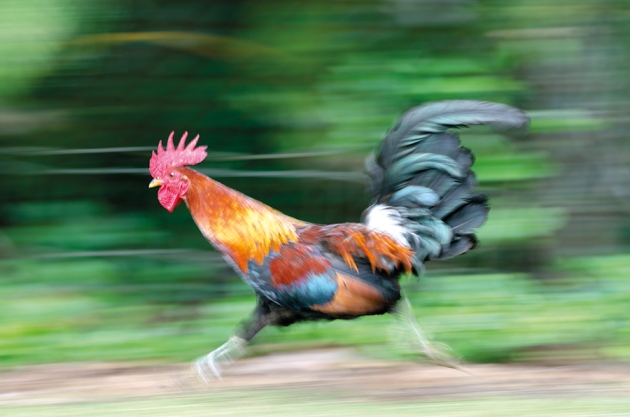
Feral chickens of Kauai

Nature reports on Hawaii's feral chickens:


Rich Reid/Natl Geographic Creative
A wild rooster in Kauai, Hawaii.
“Don't look at them directly,” Rie Henriksen whispers, “otherwise they get suspicious.” The neuroscientist is referring to a dozen or so chickens loitering just a few metres away in the car park of a scenic observation point for Opaekaa Falls on the island of Kauai, Hawaii.
The chickens have every reason to distrust Henriksen and her colleague, evolutionary geneticist Dominic Wright, who have travelled to the island from Linköping University in Sweden armed with traps, drones, thermal cameras and a mobile molecular-biology lab to study the birds.

LISTEN

Ewen Callaway investigates what happens when domestic chickens go wild
00:00
As the two try to act casual by their rented car, a jet-black hen with splashes of iridescent green feathers pecks its way along a trail of bird feed up to a device called a goal trap. Wright tugs at a string looped around his big toe and a spring-loaded net snaps over the bird. After a moment of stunned silence, the hen erupts into squawking fury.
Opaekaa Falls, like much of Kauai, is teeming with feral chickens — free-ranging fowl related both to the domestic breeds that lay eggs or produce meat for supermarket shelves and to a more ancestral lineage imported to Hawaii hundreds of years ago.
These modern hybrids inhabit almost every corner of the island, from rugged chasms to KFC car parks. They have clucked their way into local lore and culture and are both beloved and reviled by Kauai's human occupants. Biologists, however, see in the feral animals an improbable experiment in evolution: what happens when chickens go wild?

Read the rest of the article here.

Tuesday, December 15, 2015

My girls

The girls came out of their run to help me with digging some leaf litter into the soil. They enjoy their work!
 The bantam Sumatras found some greenery to work over.
 Ms. Wyandotte had to get into a planter. She's very bossy.
 Lady Fanny is a Speckled Sussex. She is a senior hen with excellent mothering abilities.
 Pixie is my Peruvian basket hen. She's about the same size as the Sumatras, but her feathers have a purple sheen, while their glisten iridescent green.
 This sweet Ancona is so lovely. Her comb reflects her condition. While she was going through her molt, it was small and shriveled. Now that she is recovering and getting ready to lay again, it is a nice red color and getting bigger. When her comb first started growing, my husband was certain she must be a rooster. he had never seen such a big comb on a hen.
 Blondie, my rosecomb Dorking, the princess of our flock. My personal favorite, but don't tell the other girls.
A Cuckoo Marans. I look forward to her dark brown eggs again soon. Maybe next week.