I spent the past week at the Society of Environmental Journalists annual conference. This year it was held in Lubbock Texas. That sounds unlikely, but it was a great place to learn about drought and water use.
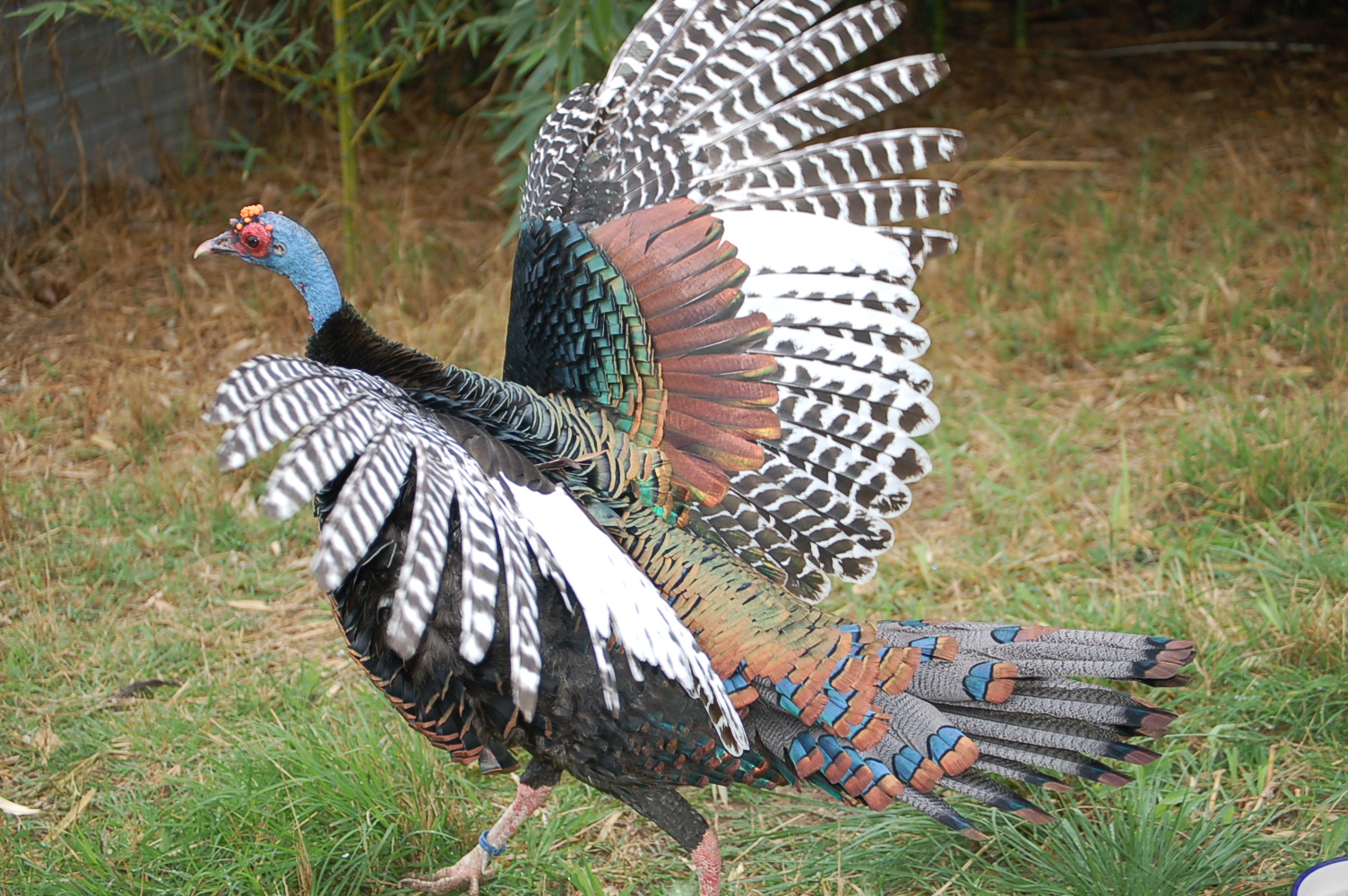
I also had the opportunity to meet Jon McRoberts, who is doing research on Ocellated Turkeys. He's the researcher who is studying those unusual birds, found only in the Yucatan. I wrote about them and his research in 2010. The article isn't posted online, so I posted it below. This photos is from Ian Waterman in England. More photos are available at
http://www.texaspeafowl.com/DSC_5449.JPG.
Ocellated Turkeys

Whirring wings flash iridescent bronze and green as the birds flutter out of the tropical forest into a quiet clearing. An occasional cluck, whistle or gobble softly indicates their presence, otherwise hardly noticeable as they scratch for seeds among the grasses, their bright blue heads held down. They are Ocellated turkeys, southern cousins of the Yucatan to our North American Wild turkeys.
Males and females are similar in plumage, unlike North American turkeys. Their name refers to the blue and bronze ocelli on their tails, eye-shaped markings such as peacocks display on theirs. Males are an inch or so taller and half again heavier than females. Their dark red legs are six inches or longer, compared with the females’ less than five inches. Males weigh 11 to 12 pounds, compared to 6 to 7 pounds for females most of the year. The females get up to 8 pounds before egg-laying season in the spring.
Males grow spurs, half an inch in their first year, an inch and a half as two year olds, and two inches or longer as mature birds. Those who have heard the calls, foot-drumming and wing-beats find them difficult to describe, but the Cornell Lab of Ornithology’s Macaulay Library has several recordings available online,
http://macaulaylibrary.org/browse/common/12008953. Linda Macaulay narrates the recordings she made in 1997.
Their blue heads are dotted with round orange to red fleshy nodules, more pronounced on males than females. Plumage is iridescent bronze-green with bluish gray tail feathers, sporting those bright blue eyes. No chance of mistaking this colorful forest bird for a Thanksgiving turkey.
As showy as they are, they were – and are still—eaten by locals. The Maya valued Ocellated turkeys for ceremonial banquets. Occupants of the palace at Mayapan, occupied for centuries before Europeans arrived, ate enough of them that 70 percent of the identifiable bones excavated from the site are from Ocellated turkeys. Although the Ocellated turkey was never domesticated as the wild turkey was, the bones at this site show the increased size that suggests they were kept captive and fattened. On the island of Cozumel, where the Spanish and the Maya first met, both Ocellated and domesticated turkeys were eaten.
Now their status is Near Threatened. The National Wild Turkey Federation hopes that with some attention, the species can recover, as North American Wild turkeys have.
“It’s a beautiful bird, a charismatic animal,” said Jon McRoberts, lead researcher for a group from Texas Tech University, National Wild Turkey Federation, the Mexican government’s SEMARNAT conservation agency, (http://www.semarnat.gob.mx/Pages/inicio.aspx), and the Union of Wildlife Management Areas studying Ocellated turkeys in their native habitat. “It’s difficult for folks to think of it in the sights of sport hunters, but the value hunting creates is saving the lives of these birds.”
McRoberts is doing the basic research to determine population levels, range, habitat needs and other information to earn his Ph.D. from Texas Tech University in Lubbock. 2010 was his first of four planned field seasons. He spent six months in Campeche, Mexico, returning to Lubbock to organize and analyze the data he collected in the field. His work will provide the basis for planning the Ocellated turkeys’ future.
Ocellated turkeys have a blue-colored head and neck with distinctive orange to red nodules, which are more pronounced on males. Neither sex has a beard. The head of the male also has a fleshy blue crown behind the snood. During breeding season, this crown becomes enlarged and the coloring of the nodules is more pronounced. The bright red eye-ring also becomes more pronounced during breeding season.
He's using radio collars to track the birds, on a large private ranch in Campeche and in the agricultural lands around Cano Cruz, a small town,. Both sites provide examples of different kinds of habitat, the open grasslands and tropical jungle. Different locales require different capture methods. On the open fields, he uses a cannon net. In the jungle, he uses flexible cloth netting traps baited with corn. He checks the traps three times a day to avoid injury or distress to the birds.
“As investigators, we have a responsibility to make sure that the birds are not in the trap any longer than necessary,” he says.
The Mexican state of Campeche on the Yucatan Peninsula is economically poor. Locals hunt the birds to feed the family. Managing the Ocellated turkeys for sport hunting is intended to bring North American dollars to the region.
“Sportsmen will pay several thousand dollars to come down here and hunt,” McRoberts says. “The local people will see that the bird has more value than one night’s meal.”
He thinks the population is already large enough to support some hunting, although he doesn’t yet have the data to support that. He saw flocks of over 300 during the 2010 field season. As North American Wild turkeys recovered from over-hunting that decimated the population, he believes Ocellated turkeys can, too.
“So much is unknown,” he said. “I get the idea they are doing pretty well.”
Tourists often see Ocellated turkeys at Mayan archaeological sites. The birds there have become habituated to humans, allowing people to approach to within five or ten feet. McRoberts is studying less accommodating birds in more challenging circumstances. Gasoline is often in short supply. It’s hot, and the roads are rough.
“I’ve had my share of flat tires,” he said. “I had to walk out of the jungle to get a new tire.”
Because Ocellated turkeys are listed as Near Threatened on the Convention in International Trade in Endangered Species, special permits are required to bring trophy birds back to the U.S. However, no permits are needed to purchase or keep live birds. Sid Drenth keeps several pairs at his Fantasia Ranch in Weatherford, Texas.
He finds them flighty and wild. To avoid disturbing them, he houses them in a pen protected by large shrubs. Because he paid $800-$1,500 each for them, he
The Ocellated turkey is easily distinguished from its North American cousin. The body feathers of both sexes are an iridescent bronze-green color. Hens may appear duller in color with more green than bronze. The breast feathers of the sexes do not differ so they cannot be used to determine the sex.
“Anything that walks by can spook them,” he said.
Beautiful as they are, they’re too wild and sensitive to make good backyard birds. Drenth has never been able to breed them successfully, despite his experience with other exotic birds. He keeps peafowl, cranes, ibises, curassows and other African birds. Few people ask to buy one from him.
“If this is something you really like, be prepared for a loss,” he said.
Several zoos in the South and Southwest have Ocellated turkeys on display. Few of them have bred the birds successfully, either.
Their stunning plumage decorates the trees of the Yucatan jungle, delicately venturing onto the open grass to eat and breed. Perhaps that’s enough for this unusual native American turkey.
For more information, see the Fantasia Ranch Texaspeafowl website:
www.texaspeafowl.com, or write to Sid & Beverly Drenth, P.O. Box 1029, Weatherford, TX 76086-1029;
texaspeafowl@aol.com.
 The eggs supplied by factory farms as well as many small, local farms
come from hens that have been bred not to brood — i.e., not to want to
sit on, incubate and hatch their eggs with a view to mothering a brood
of chicks. The behavior, after all, is an inconvenience to commercial
farmers who want their hens to be as productive as possible laying eggs
rather than warming them.
The eggs supplied by factory farms as well as many small, local farms
come from hens that have been bred not to brood — i.e., not to want to
sit on, incubate and hatch their eggs with a view to mothering a brood
of chicks. The behavior, after all, is an inconvenience to commercial
farmers who want their hens to be as productive as possible laying eggs
rather than warming them.